
ASAB supports colleagues in schools, colleges and institutes of higher education who teach animal behaviour. Download our fun and engaging teaching resources!
NEWS
ASAB EDUCATION COMMITTEE 2026 INFOGRAPHIC COMPETITION
Help us to celebrate animal behaviour and share knowledge with others.
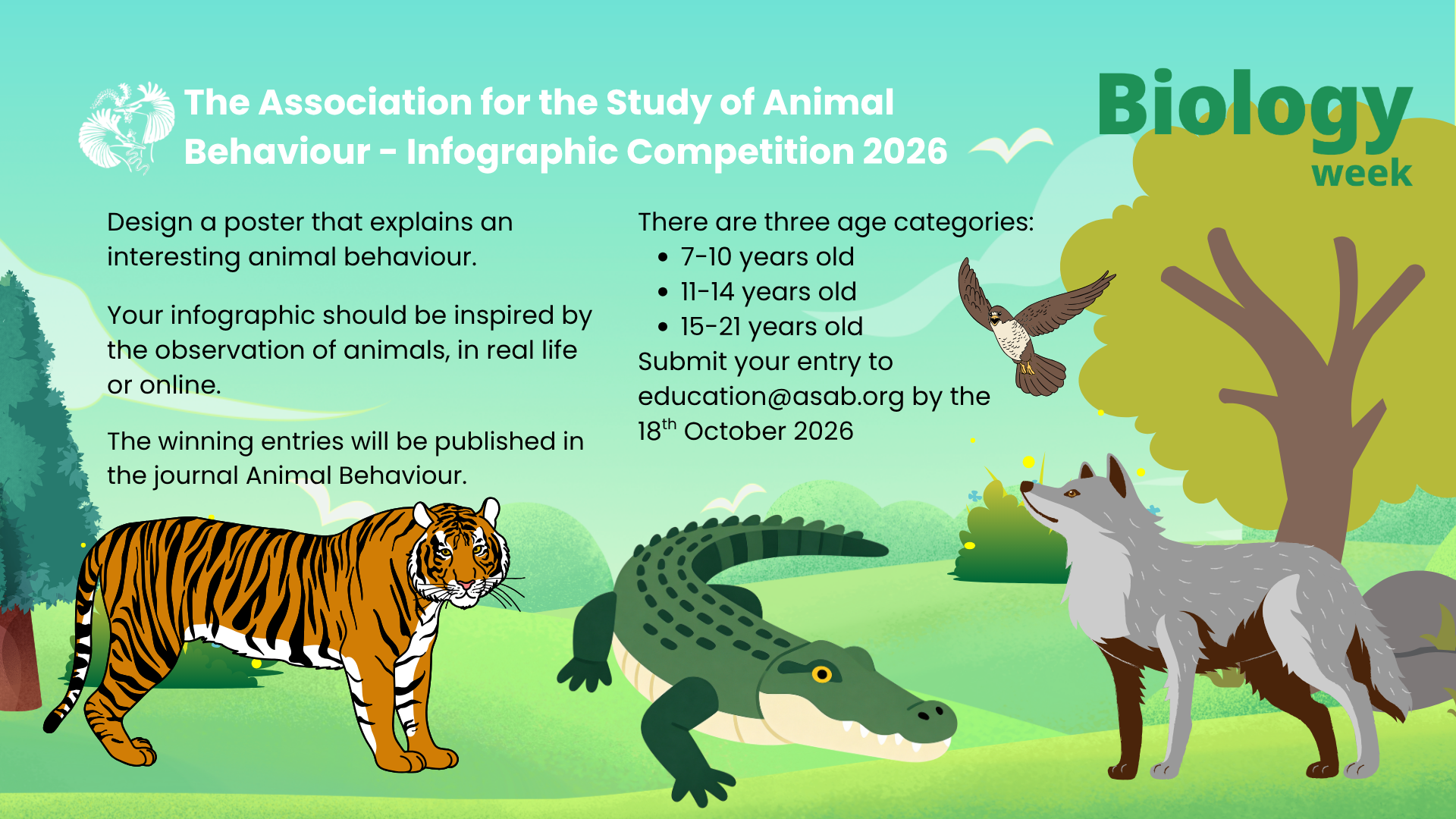
To help celebrate Biology Week with The Royal Society of Biology, this 2026 competition is for young people to design a poster that contains images and information about the animal behaviour of one, or multiple species of non-human animals.
You can draw, paint, sketch or digitally create artwork that captures the behaviour of animals. There are no restrictions on the type of drawing, painting or poster that you create, it must include information on the behaviour of the animals you are highlighting.
The winning infographic in each category will be published inside the scientific journal Animal Behaviour.
Email a picture of your infographic and completed entry form to education@asab.org by midnight on the 18th of October 2026. If you have any questions, please email Charlotte at education@asab.org Terms and Conditions are here.
2025 Results
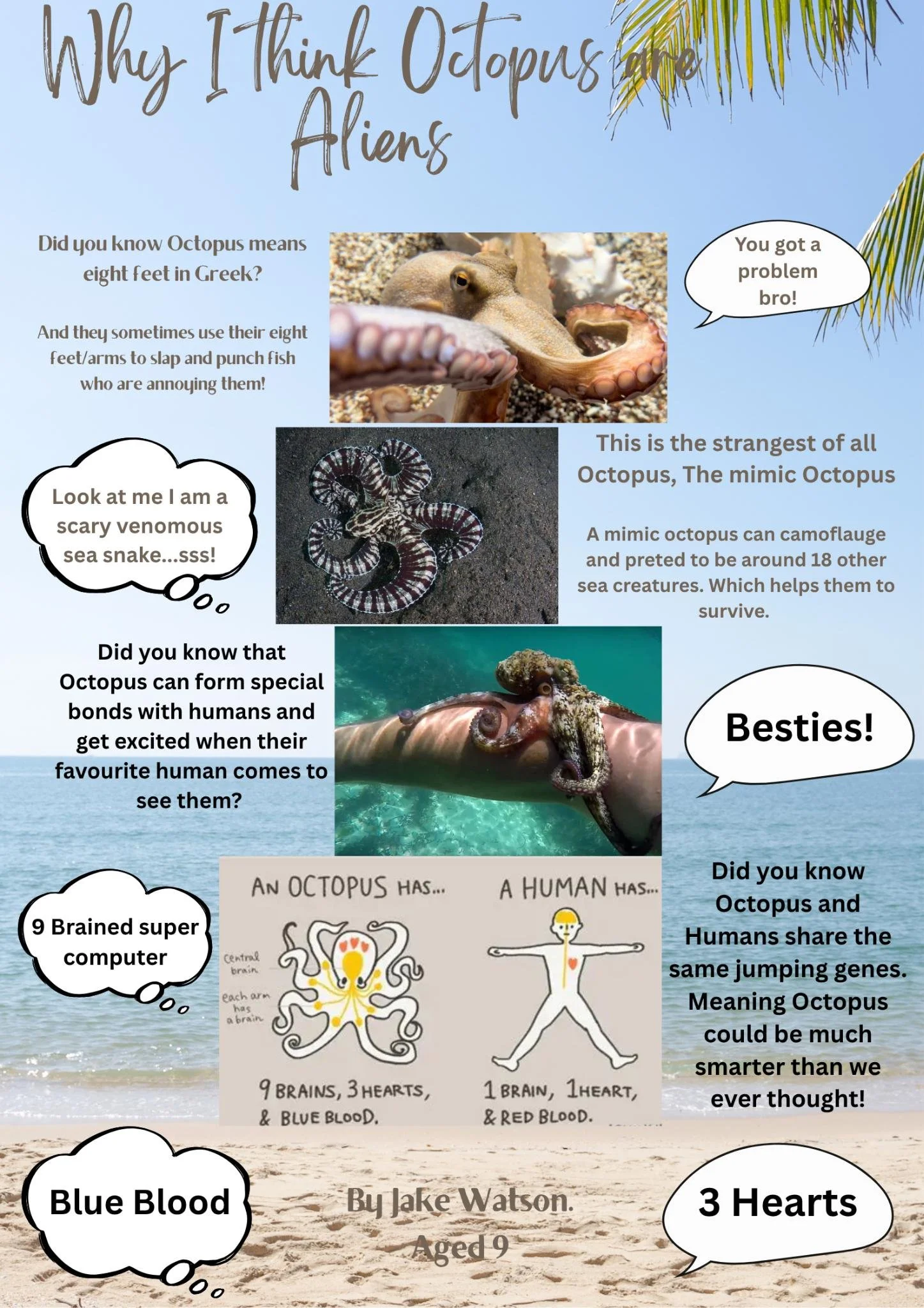
Congratulations to Jake Watson - winner of the 7-10 years age category

Congratulations to Rosalind Turner - winner of the 11 - 14 years age category
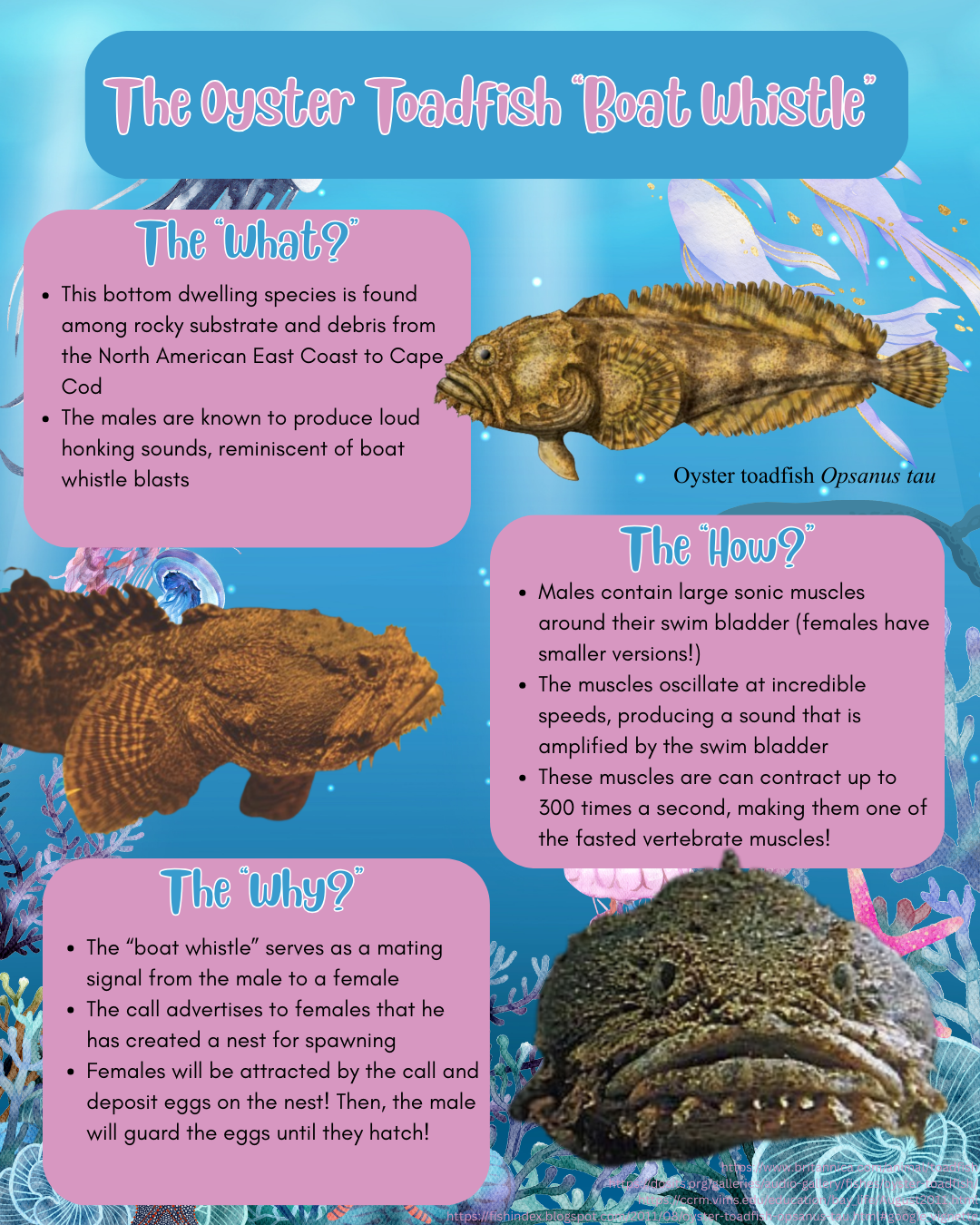
Congratulations to Justin Looper - winner of the 15 - 21 years age category
This 2025 competition was for young people to design a poster that contains images and information about the animal behaviour of one, or multiple species of non-human animals.
The artwork had to capture, describes and explains the behaviour of animals. The winning infographic in each category will be published in our scientific journal Animal Behaviour.
Here is a selection of our judges favourites from all the wonderful entries.
Well done everybody


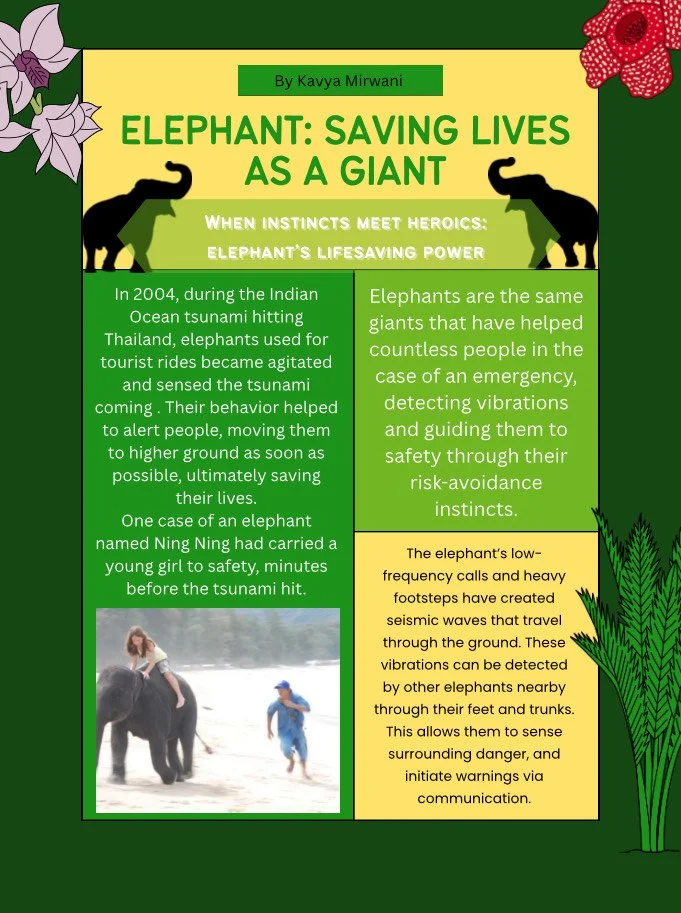


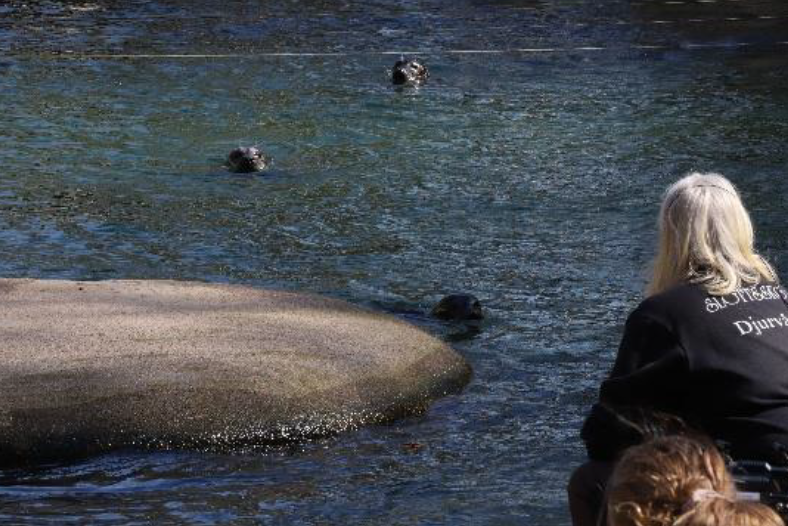
Sälfie-ID: Working together for seal research.
Sälfie-ID is discussed during the daily Mat&Prat (Food&Chat) harbour seal feeding sessions at Slottsskogen Zoo, Gothenburg.
Sälfie-ID (based on the Swedish word säl “seal” and pronounced as Selfie) connects with the Swedish target participants. The project aims to engage the public in research into seal behaviour and ecology by encouraging them to submit images and reports of seal sightings. Sightings can be submitted through the Sälfie-ID website. Which is in both English and Swedish, or via email to salfie2023@gmail.com. The website also contains an overview of Swedish seals and a blog about current seal research. A primary goal of the project is that people submitting sightings, or curious about seals, have easy access to the facts.

Catch Them Young
James Bukie, from the Federal University of Agriculture in Makurdi, Nigeria, Organised this extravaganza of events to correspond with the International Day of the Drill on the 4th May. The day increased the awareness of local people to the dangers faced by the drill monkeys. The event included talks, short dramas and debates about the drills. Open to the everyone, it was attended by community heads, students, friends and families. In the photo with James is Sidrock, who performed his bespoke song about ‘the beautiful beast in the heart of the jungle’. Press play below and have a listen to this brilliant song, which evokes the wilds of the Afi Mountain Wildlife Sanctuary.
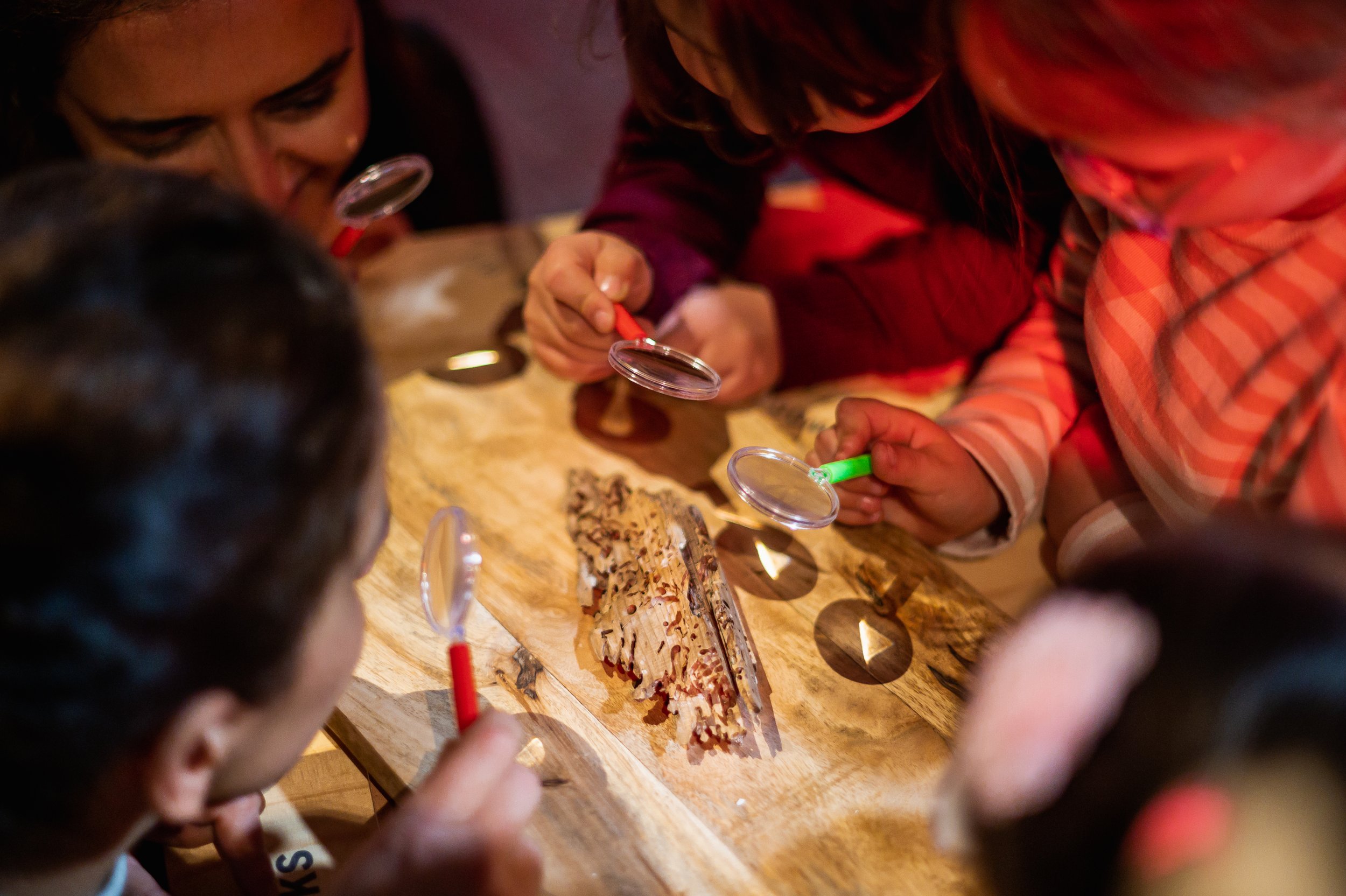
The Brunel Museum, Thames Tunnel
The ASAB Education Committee Public Engagement Grant enabled the Brunel Museum to tell the story of Teredo navalis, aka shipworms. The exhibition was designed in collaboration with scientist Dr Reuben Shipway and covered the key elements of shipworm behaviour from diet to habitat. The Brunel Museum celebrates the Thames Tunnel, the first tunnel dug under a river anywhere in the world.
October 2022
ADHD AWARENESS MONTH

October is ADHD awareness month, the purpose being to educate people about ADHD by disseminating reliable information based on the evidence of science and peer-reviewed research. You can see more on the website here: https://www.adhdawarenessmonth.org . To support ADHD awareness month, we have interviewed three animal behaviour scientists (clockwise from top left in the photo) David, Mukta and Sophie. They have agreed to share their experiences of living with ADHD, in order to support young people interested in a career in science.
-
Thank you for agreeing to take part in this conversation with us David. David is a scientist studying animal behaviour and cognition. In particular, David is interested in how animals find their way back to important locations in their natural environments, and the role that memory plays in this behaviour. Working with wild hummingbirds in the Canadian Rockies, David has found that these tiny birds remember the locations of important flowers by using nearby visual landmarks. Interestingly, these wild hummingbirds appear to use landmarks in a similar way to how insects use landmarks, leading David to referring to hummingbirds as “feathered bees”.
Attention deficit hyperactivity disorder (ADHD) is a condition that affects people's behaviour. Around 2% of adults in the UK are thought to have ADHD. People with ADHD can seem restless, may have trouble concentrating and may act on impulse. Most cases are diagnosed in childhood, however, David you told me that you weren’t diagnosed with ADHD until you were older, why do you think this was the case?
To be honest, I think a lot of it was to do with stereotypes about what ADHD looks like. I was a shy child (although very chatty when I got going), well behaved at school, and academically successful. This didn’t really fit with the stereotypical ADHD picture of the “badly-behaving”, academically struggling child who can’t sit still. I think nowadays there is a lot more understanding that this stereotype is just one way ADHD can manifest. Many other people are more inattentive than hyperactive, and superficial academic success can hide a lot of struggles behind the scenes. Once I found out more about ADHD and spoke with my family, we saw a lot of evidence for ADHD in my childhood that we mostly overlooked. One of the parts of being assessed for ADHD are questionnaires filled out by your parents (about your childhood behaviour) and by your partner (about your current behaviour). My mum and my wife both found this very funny as it seemed like someone had compiled a set of questions about me specifically and was asking them to score how much I resembled this person on a scale of 1-5.
How did you feel when you were diagnosed with ADHD?
It was a bit surreal really. I had internalised this narrative that my disorganisation, procrastination, and other issues were mostly due to me not trying hard enough or not knowing something everyone else knew. Before I even realised that it was possible that I had ADHD, I recognised these issues were a problem and tried to solve them. I attended multiple workshops on time-management, personal organisation, and went through cycles of “self-improvement” which rarely last more than a week or two. Constantly trying and failing to do what other people seem to do (relatively) effortlessly was soul crushing. When I was diagnosed, and read accounts from other people with ADHD, it was a revelation. It turned out that lots of people, before they were diagnosed, had experienced the same frustrating cycle of constantly trying to improve and constantly failing. I learned about why I struggled to remember some things, and why my attention span seems either “all in” or non-existent. And by knowing these things, I could see why my previous attempts to get on top of things failed and could figure out some pointers for trying things differently.
What is it like to live with ADHD? How does it influence your life?
What I think a lot of people don’t realise (I certainly didn’t) is that ADHD is not about lacking attention. It is about regulating attention. There are times I really struggle to start something or to focus on what I am doing. There are other times when I struggle to stop doing something and am too focused on the nitty-gritty that I lose sight of the big picture. This means I can spend a whole day working on a single sentence or line of code, even though this means that the manuscript or analysis isn’t getting done. There are also memory problems, particularly working memory which is what you use to keep information “in your head” during a task. I have an excellent memory for obscure trivia, but I constantly forget information I have just been told, or why I am doing what I am doing. If you combine this with the lack of focus, I might need reread a sentence several times in order to actually hold on to what is said. Finally, there is the impulsivity. I am not particularly hyperactive, but I can be very impulsive. I might go to the shops for a pint of milk and buy several meals worth of food and drink and totally forget about the milk. The impulsivity also makes me struggle to stop talking. I very easily go off on tangents, don’t give people room to speak, and I often interrupt. This isn’t because I don’t care about what other people have to say, or that I think I’m super-interesting, it is because the executive functions we all use to regulate our behaviour are impaired in people with ADHD.
How do you deal with your ADHD? What helps? Do you have treatment?
Even though I struggled before being diagnosed, I can look back and see strategies that I was using to try and get things done. I work significantly better out of the house and out of the office. I wrote most of my PhD thesis in cafes and libraries, and I have learned to embrace that. This was difficult during the pandemic, but I have found it much easier to learn where I work well than try to train myself to work better in more appropriate spaces. I also know that I cannot be trusted to remember things, so I write everything down, even if that means carrying around a small notebook (although that can be tricky as I often forget the notebook). I am also terrible for misplacing my keys or my phone or my wallet, meaning that I would spend ages looking for them every time I left the house as I couldn’t get into the habit of having a safe place to keep them. I now use Bluetooth trackers on my keys and wallet, and these can also be used to find my phone. I still occasionally turn up at a café without my wallet, but I no longer spend an hour looking for it before leaving the house.
In terms of professional help, I am still working with the NHS psychiatrist who assessed and diagnosed me, and we are still in the process of figuring out if there is a medication that will help me with the symptoms. When I was diagnosed, I was already seeing a counsellor for Obsessive Compulsive Disorder (which is a whole other thing…) who conveniently also specialises in ADHD. I talk to her every two weeks and she has helped me set more realistic goals and strategies.
Are your friends and colleagues understanding of your condition?
Yes, mostly. When I have brought it up people are very supportive. And I have tried to be very open about it. However, it can be a bit challenging to explain to people as it can sound like I’m trying to medicalise something everybody goes through from time to time. I still get the occasional “oh, but everybody’s like that” or “have you tried this [one weird trick]”. I know these comments are well-meaning and people just want to reassure me that they’ve been there and that they understand, but when I keep encountering similar responses over and over, it can get quite frustrating. Lots of people do have ADHD, but most people do not. What works for most people might not work for someone with ADHD. Lots of people can relate to the symptoms of ADHD (who hasn’t had issues with procrastination?), but for people with ADHD these symptoms are indicative of deeper problems with attention, memory, and other executive functions. I think this distinction between observable symptoms and executive disfunction is really important when it comes to understanding and helping people with ADHD but is difficult to explain.
What is the worst thing about having ADHD?
Where to begin? I really struggle to manage complex projects with lots of moving parts. It almost feels as though I can’t quite fit it all in my head. Even smaller projects like writing a short paper can be oddly overwhelming. This doesn’t just affect work, it is also true of organising a holiday, packing a suitcase, or even putting on a load of laundry. When you struggle to break big tasks into smaller ones, “just getting on with it” seems daunting.
There is also the social impact of ADHD. I hate letting people down, but when you struggle to organise yourself and find prioritising tasks difficult, there is a lot of work that gets done at the last minute. This is exhausting for me, but it is also incredibly unfair for anyone who has to work with me. Big projects like fellowship or grant applications often come down to a last-minute scramble to get the necessary information, permissions, and recommendations. I am lucky enough to work with very kind and patient people, but it doesn’t make it feel any better when I end up asking for things at the last minute despite swearing that this time I was going to give myself and everyone else plenty of time. This is also true with excessive talking in conversations. I hate feeling like I am dominating a conversation, but I can feel out of control when it comes to stopping talking or staying on topic. Again, people have been very nice about it, but I don’t like it and it makes even the prospect of social interaction quite nerve-wracking.
What positive influences has having ADHD had on your life?
I mentioned above that I used to believe that I was just not trying hard enough. Being told that there is more going on, and that it wasn’t due to lack of discipline or being lazy, felt like a massive weight being lifted. Learning more about how my mind works, and why some strategies work better than others, has been genuinely life-changing, and has shaped how I look back on my life. Not everything is about ADHD, but several periods of my life, including issues I faced at school and university, make a lot more sense now. I am also trying to embrace the fact that my brain works a bit differently. I have focussed a lot on the problems caused by ADHD, but there are some upsides. I found it really interesting to read that people with ADHD are often quite creative, for the simple reason that they are easily bored and so constantly seek new things. I have certainly found that in my attitude to my own research. My interests jump around a lot, from spatial memory to robotics to eye-movements (to name just the last few weeks), and I think this can lead to seeing things in a different or new way. Being impulsive can also be fun as well as frustrating. I get presents for my wife just because I saw them and thought she would like them. In many cases the line between a positive aspect of ADHD and a negative is a fine balance. I can sometimes feel like my mind is constantly racing, and that can be great for coming up with ideas, but it is terrible if you need to focus or want to go to sleep. I have been told I can be fun to talk to because the constant stream of consciousness can be interesting or entertaining, but this is something that has also caused me problems in other social setting or in interviews when it is necessary to be concise and stay on topic.
When you were young, what did you want to be when you grew up?
It depended on the day. At different times I wanted to be an architect, an archaeologist, a palaeontologist, an animator, a cartoonist, and a Pokémon master. I think I would be happy that I grew up to be an animal behaviour scientist. I was a very bookish child and really into non-fiction, especially Horrible Histories and anything about dinosaurs. I was also really interested in animals. Some of my favourite books were collections of fun facts about birds and reptiles. I am not sure I knew exactly what a scientist actually did but I loved collecting facts and I guess you could say that science is all about finding new facts!
What would you like to say to young people who are managing their own ADHD at the moment?
Just because something that works for everyone else doesn’t work for you, it doesn’t mean nothing will work for you. Talk to people. Use the resources that are available. Don’t be afraid to ask for help. And try to stay positive. Knowing you face challenges others don’t, can make it seem like certain careers or futures are off-limits. But this is not true. There are successful people with ADHD in all parts of society, including doctors, scientists, and teachers. So, while it might not be easy, ADHD doesn’t mean you can’t be happy and successful in what you want to do. And in learning how to get there, in learning how to manage your mind and find what works, you will learn about yourselves as well.
-
Thank you for agreeing to take part in this conversation with us Mukta. Mukta is a scientist studying evolution of social behaviour and cooperative breeding. After a bachelor’s in industrial microbiology and a master’s in biodiversity she eventually turned towards animal behaviour. During her PhD, she focused on the effects of predator experience in early life on adult social behaviours in cichlid fish. She is now more interested in the evolution of cooperative breeding in birds and has been working on the chestnut-crowned babblers from Australia. She is also interested in working towards making science more inclusive and equitable. This interview aims to share her experience of living with ADHD, in order to support young people interested in a career in science.
Attention deficit hyperactivity disorder (ADHD) is a condition that affects people's behaviour. Around 3% of adults are thought to have ADHD. People with ADHD can seem restless, may have trouble concentrating and may act on impulse.
How did you feel when you were diagnosed with ADHD?
About a year into my PhD I was quite severely depressed and constantly overwhelmed. That is what I went to seek help for in the first place. The psychiatrist immediately suspected that there were other things at work than a simple depression. When they revealed this to me, I immediately and obsessively looked up every conceivable mood and personality disorder to see what fit me! Obviously, by the time I was officially given the diagnosis for Autism and ADHD, it no longer was a surprise! Growing up in India, there wasn’t much awareness around neurodivergence in general. Only extremely hyperactive and underachieving kids sometimes got the ADHD diagnosis. I was underactive and overachieving! I was therefore conditioned to think that any failure is my fault for not trying enough. So, my first feeling after the diagnosis was that of huge relief, that it wasn’t actually me decidedly not trying every second of my life! Then came a period of remembering and re-living every single incidence when I didn’t achieve my goals or when someone told me that I was not trying hard enough or that I was lazy and careless, and assessing whether I was indeed slacking off in that moment or genuinely struggling. Much as my working memory is non-existent, my long-term memory is unforgivingly sharp, so this was a long and arduous journey! However, it eventually morphed into trying to understand neurodivergence from a behavioural ecologist’s perspective. I’m still actively pursuing this quest (and need I say, obsessively so).
What is it like to live with ADHD? How does it influence your life?
It’s a bit like Goldilocks, you know? Except instead of three bears, it’s a multigenerational joint family of bears and yet not a single porridge, not a single bed is optimum for you! Not having a variety to choose from is unacceptable to me but having options throws me in a decision paralysis. Result? I often skip a meal or don’t buy the thing I need! I can make to-do lists but find it hard to get started on them because in the few minutes to few hours between making the list and starting on it, the priorities have shifted in my head for unknown reasons! I always miss deadlines or work until the last possible minute. These days I feel like I don’t have the energy to pull all-nighters before deadlines so I try to start way too much in advance. But so far I have always encountered some roadblock that throws me off-schedule and unable to recover, I have always ended up doing everything at the moment. I can’t even imagine how annoying it must be to work with me with me always pushing deadlines and leaving things until the last moment!
How do you deal with your ADHD? What helps? Do you have treatment?
Moving countries every few years is a big part of academia and the biggest hurdle in accessing or continuing treatment. I have never received any treatment for ADHD until now for the same reason.
My self-treatment is good quality headphones and copious amounts of coffee! I have a few playlists that I choose from depending on the task at hand (instrumental-only for writing/behavioural observations but vocals are ok for processing and analysing data/lab work). I have observed that coffee gives me a short window of about an hour of good focus, so I schedule the most difficult tasks for after the mid-morning or afternoon coffee (or simply drink unhealthy amounts of it until I have finished the task. Yes, regret does always follow). My biggest problem is getting up in the morning and getting the day rolling. Getting a cup of coffee immediately after waking up and following it up closely by an hour (at least) of workout really helps easing into the day. Working out also helps regulating sleep, which is a big problem for me even in the absence of coffee!
Are your friends and colleagues understanding of your condition?
I don’t know what I would do without my friends! Most of my close friends are the other students I met during the PhD and they are extremely supportive. I was almost always overwhelmed and ready to crash and burn throughout the PhD and I would not have made it without my friends. From forcing me to take breaks to cheering me on over texts for a few hours before thesis submission because I was too overwhelmed to continue to the finish line, to listening to me go off on tangential rants, they did it all! Now that we are in long-distance friendships, the rants have switched to long texts, but everything else remains the same and I still rely on them for support just as much. My postdoc on the other hand coincided entirely with the pandemic and I didn’t even have a team, leave alone new friends. However, my supervisor was (is, we are still working on some of the projects we started then) very considerate. They always listen to my concerns and make small changes to their communication style when necessary.
What is the worst thing about having ADHD?
The stress of keeping up. Most academics, even the most organised ones, end up working countless extra hours. I am always anxious that I will never be able to keep up with even the basic expected productivity and will end up being squeezed out of academia. However, unlike the deadline-anxiety this existential anxiety doesn’t spring me into action. Instead it acts as an additional distraction. It’s a vicious, downward spiral really!
The worst thing about telling people about having ADHD is definitely the “sure, but no one is actually organised” and “but you should meditate, it’s good for focus”. It makes me want to not share, which of course is not helpful in most scenarios!
What positive influences has having ADHD had on your life?
Where do I even begin, there are so many! When I’m in hyperfocus, I get unimaginable amounts of work done. That is probably how I managed to fly under the radar all these years! I have lost the count of hobbies I have had throughout life. I’ve been so conditioned to think about how many things I quit that I sometimes forget to think how many things I actually pursued to begin with. And there is no chance I’m going back to any of them again, so I will only be adding more things to that list even in the future. Even career-wise I have drifted through many fields (just the general theme of ‘biology’ being the common thread) and I have a feeling that is going to continue. It does sometimes make me feel like I belong nowhere but on good days I feel like I can belong anywhere I want, with just a tiny bit of homework. I’m also someone who always “sees the world upside down”. Consequently, I always have something different (but sometimes also tangential and unhelpful) to contribute to a scientific (or any) discussion.
When you were young, what did you want to be when you grew up?
Exactly what I am! Although my naïve childbrain did think I would have tenure by now but here I am struggling to get a postdoc. In all seriousness, I did want to be a behavioural biologist since I was six or seven and I saw a book on behavioural ecology. I have no recollection of which book it was, but I remember some of the pictures in it and that it had Tinbergen’s experiments in it. I was too young to even read English, let alone understand it but I remember my dad explaining them to me. And believe me when I say I have never been drawn to any other thing so strongly in life! At that time it was impossible to formally study animal behaviour at university level in India and leaving the country was financially impossible so I made my peace with whatever other kind of biologist I could be! I went with paths of least resistance (admission based on entrance tests rather than previous grades) while choosing bachelor and master programs and then turned towards behaviour as and when I could. My specific interest in social behaviour is relatively newfound. It is very much tied to the process of understanding myself and the world around me.
What would you like to say to young people who are managing their own ADHD at the moment?
It is hard to live in a neurotypical world. It is especially hard if you are also adjusting to a new country, a new language, and a new culture at the same time. But that doesn’t mean it is impossible. It doesn’t have to be only unpleasant either. Ask for help when you need it. There are more people willing to help than not. Keep your support network close even if it means over texts or calls. Don’t ever suffer in silence (my postdoc advisor, 2020 😉). Most importantly, you do you! You know yourself better than anyone else so define your own boundaries, your own rituals that get you ‘in the zone’. Lastly, if you’re really struggling, now or ever, know that you are not alone. Someone always sees you. I see you and I’m sure so do all the other interviewees and readers 😊
-
Thank you for agreeing to take part in this conversation with us Sophie. Sophie is a master student studying at Eberhard Karls University of Tübingen, Germany.
After finishing my Bachelor recently (1 year late, classic ADHD behaviour) I now started my M.Sc. in Archaeological Sciences and Human Evolution with a focus on Stone Age Archaeology (funnily enough, I took some of the classes already so will only have to do 1 year instead of two, also classic ADHD I guess haha!). It is all very chaotic and many aspects of the human past interest me. My goal and focus of interest though is a combination of cognitive archaeology, primatology and a few neuroscientific methodologies to try to recover information about how humans used to communicate and how our langue developed through the millennia. Cultural evolution therefore is my second focus as human communication and language are highly cultural phenomena. The interest in human evolution and communication appears to be a common thing in people with autism and adhd (I am blessed with both), since we kinda just wanna understand how to be a person. Hope this is a good intro to how I got where I am now, what I do now, and how my neurodiversity actually brought me here 😊
Attention deficit hyperactivity disorder (ADHD) is a condition that affects people's behaviour. I actually prefer ADHC (condition, as I feel like while adhc can be disadvantageous in some scenarios, it is advantageous in others and I do not feel like it is a disorder. So I’ll be using ADHC from here on but feel free to explore different options reg. terminology!) I’d also like to mention that it is not a deficit in attention like the name implies, but more a mis-regulation. Around 3% of adults are thought to have ADHD (many of them probably also have autism like me since the two are genetically related. People with ADHD can seem restless, may have trouble concentrating and may act on impulse.
How did you feel when you were diagnosed with ADHD?
Actually, I felt really relieved when I learned about my ADHC because it felt good to be able to name what makes certain things harder for me. I never found it scary or anything, it did not change me but only help me communicate why I struggled sometimes.
What is it like to live with ADHD? How does it influence your life?
In my everyday-life I’d say the biggest struggle are constantly losing my keys (like literally every day), handling money as I tend to shop impulsively (i. e. buying stuff I do not need and ending up having to eat pasta for like 3 weeks of the month), and executive disfunction things like desperately wanting to get up and take out the trash but physically not being able to do it. It is mostly small things but they pile up really quickly and that causes a lot of stress (which does not help lol).
Academically the main struggle is keeping deadlines. I always do but I procrastinate A LOT. Like if I know I have to hand in an essay in 8 weeks I will not work on it for 7 weeks and 6 days and then write 10 pages in a SUPER stressful night. I will still be stressed the full 8 weeks though. I wrote my Bachelor thesis in 4 days (in which I slept like 10h in total maybe). I need the deadlines though by otherwise I’ll never do anything. So the best thing for me would be to tell me ‘hand this in tomorrow’. So I guess an advantage is that I am great under pressure! 😊
How do you deal with your ADHD? What helps? Do you have treatment?
I am not medicated but I do drink A LOT of coke and eat a lot of chocolate which kinda is like self-medication I recently learned. What really helps is physical activity. I used to run but that did not do much for me, now I started bouldering a few months ago and that really helps a lot. Not only is like whole-body stimming but it also uses up some of that extra energy I build up over the week. Fidget toys also help although I try to not use them too much since I am afraid of distracting fellow students in lectures. But I do notice how I can listen and focus better when my hands are busy. Also listening to music is a big part of my life as sometimes my brain feels like there are 72 open tabs and when I listen to music I can focus on that one thing and not hear my thoughts for a second.
Are your friends and colleagues understanding of your condition?
Definitely! I am very fortunate to have such a great support system. Sometimes it is hard to differentiate the autism and the adhc but if for instance at a party I am overstimulated I can just drop out for a while and my friends won’t ask what is up or be weird when I come back. When I am under-stimulated sometimes I say that I am bored and when I have a fidget then it helps to keep focusing on my friends story for example. They are not offended bc they understand how my brain works. It is like a cup that constantly changes size so sometimes it overflows and sometimes it is dry like the dessert. They help me regulate the liquid inflow into my cup, so to speak 😊
What is the worst thing about having ADHD?
I would honestly say the procrastination/executive dysfunction kinda stuff. That is the only thing that I would say takes away quality of life simply bc it makes my life unnecessarily stressful. I have found though that the more I fight it the worse it gets so I try to just go with the flow and work when I can focus and do not force myself to try to work when I can’t.
What positive influences has having ADHD had on your life?
In times of hyperfocus it is really fun! I can pick up things quicker than others and am usually good at new hobbies fairly quickly. The downside is that I spend a lot of money on a new hobby I drop after like two weeks. But it makes life fun to constantly learn new things! Which is also why research is so much fun for me, it always keeps moving and changing 😊
When you were young, what did you want to be when you grew up?
I always wanted to be a Max-Planck researcher (and am still working towards the behavioural ecology position there 😉). I think what fascinated me is the adventure of discovering new things and being able to work with many different people. That is scary for the autism but in this case, the adhc excitement is stronger than the fear of people I guess.
What would you like to say to young people who are managing their own ADHD at the moment?
Definitely be proud of who you are! Adhc gives you a unique perspective and the opportunity to think outside the box. Neurodiversity is just another form of communicating but it is just as efficient as neurotypical communication 😊 Try different things like fidgets, physical activity, music, maybe puzzles, and see what works FOR YOU. And definitely do not force it, if you struggle from executive dysfunction one day, trust in your adhc to also kick in the next day when you need to finish that assignment or go take that shower or brush your teeth. It is ok that ‘small things’ like doing the dishes are equally hard as writing a 10p essay! Your best looks different every day and that is fine 😊
Black History Month
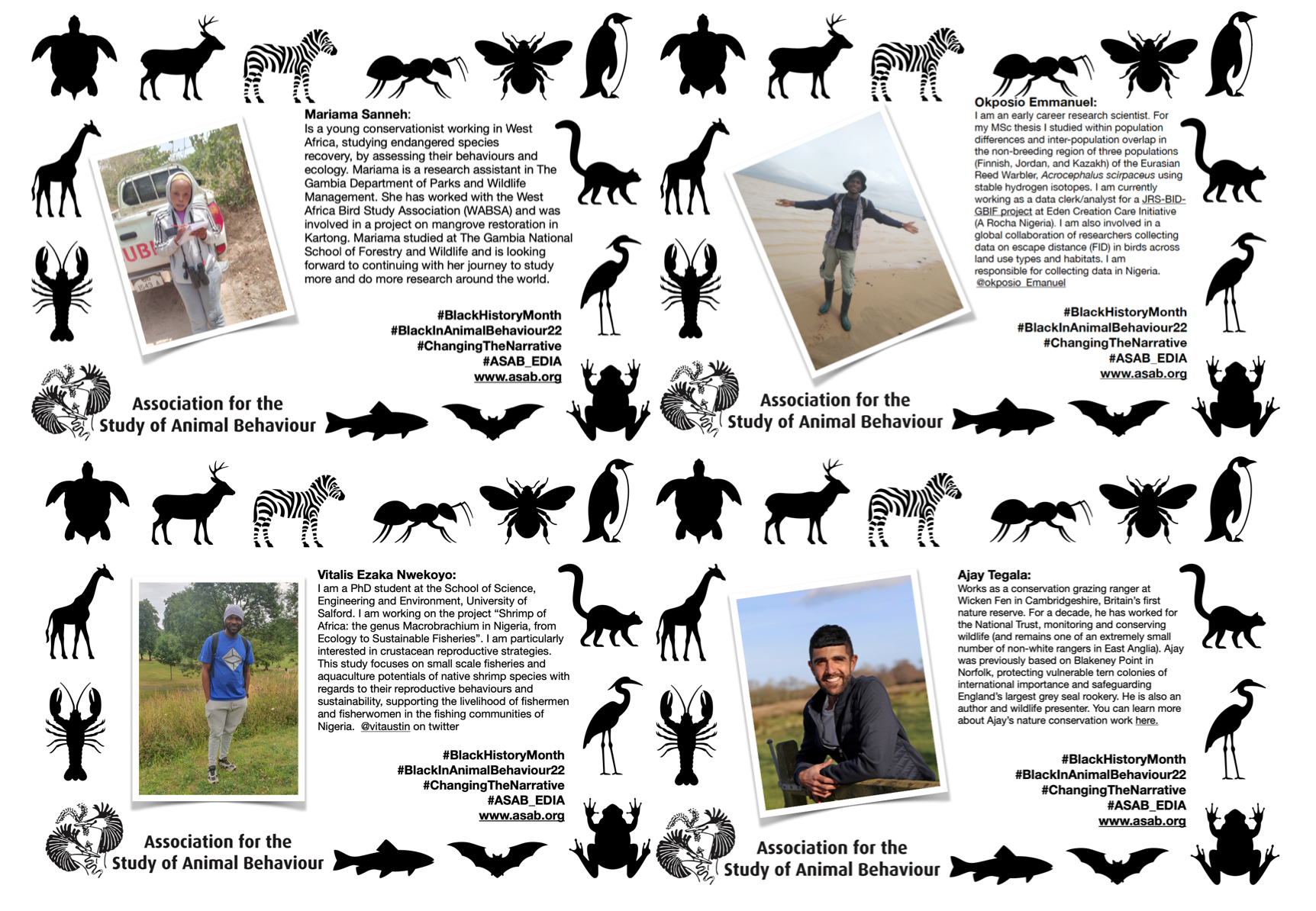
Week Three
Okposio Emmanuel’s current project is 'Raising the profile of data for the conservation of four forested African landscapes.' https://www.gbif.org/project/BID-AF2020-140-REG/raising-the-profile-of-data-for-the-conservation-of-four-forested-african-landscapes
Ajay Tegala’s book is here: https://lnk.to/TheUniqueLifeofaRangerTW
Week Two
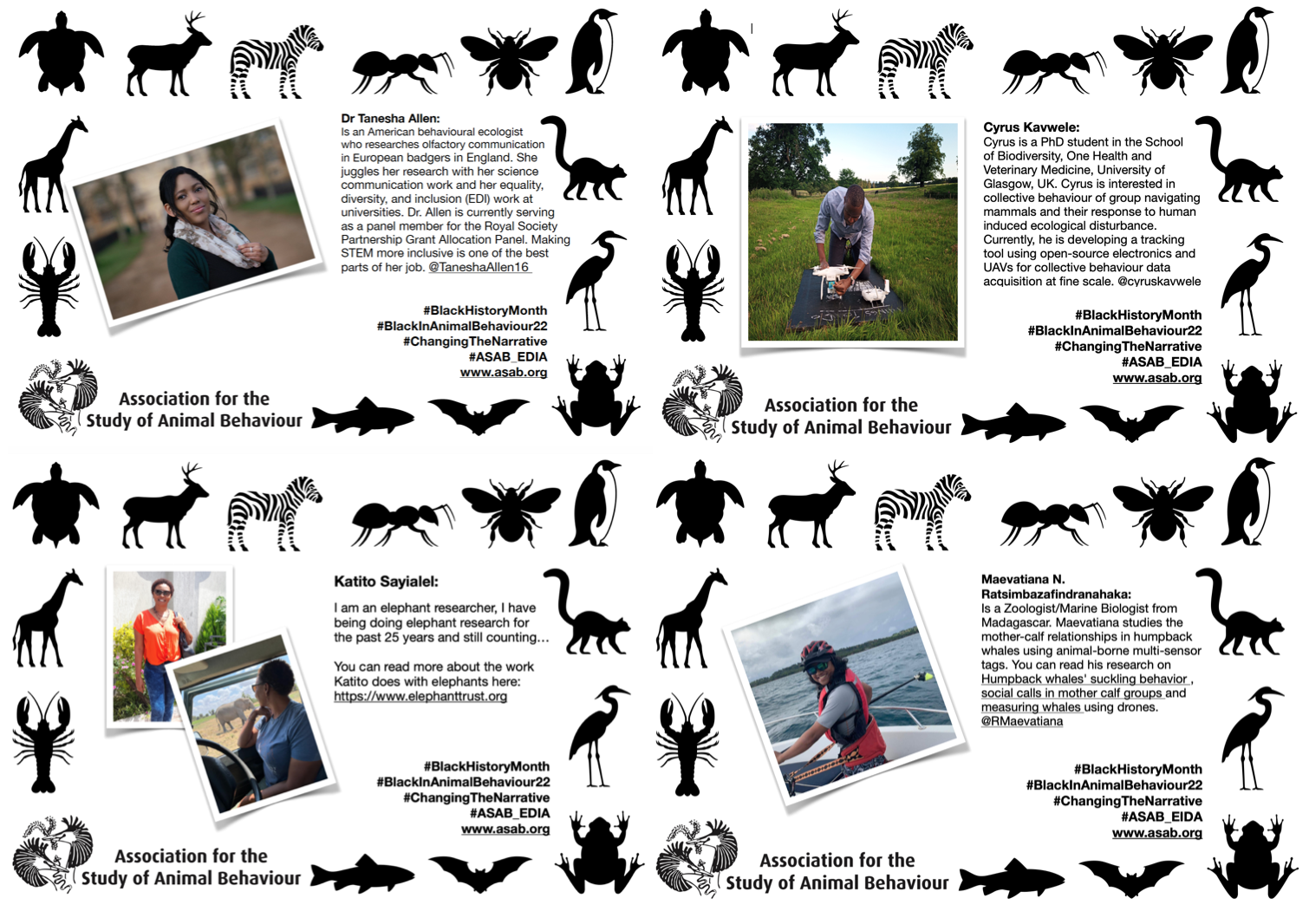
Dr Tanesha Allan’s website is here.
Maevatiana Ratsimbazafindranahaka’s research is here.
Katito Sayialel works with https://www.elephanttrust.org
Week One
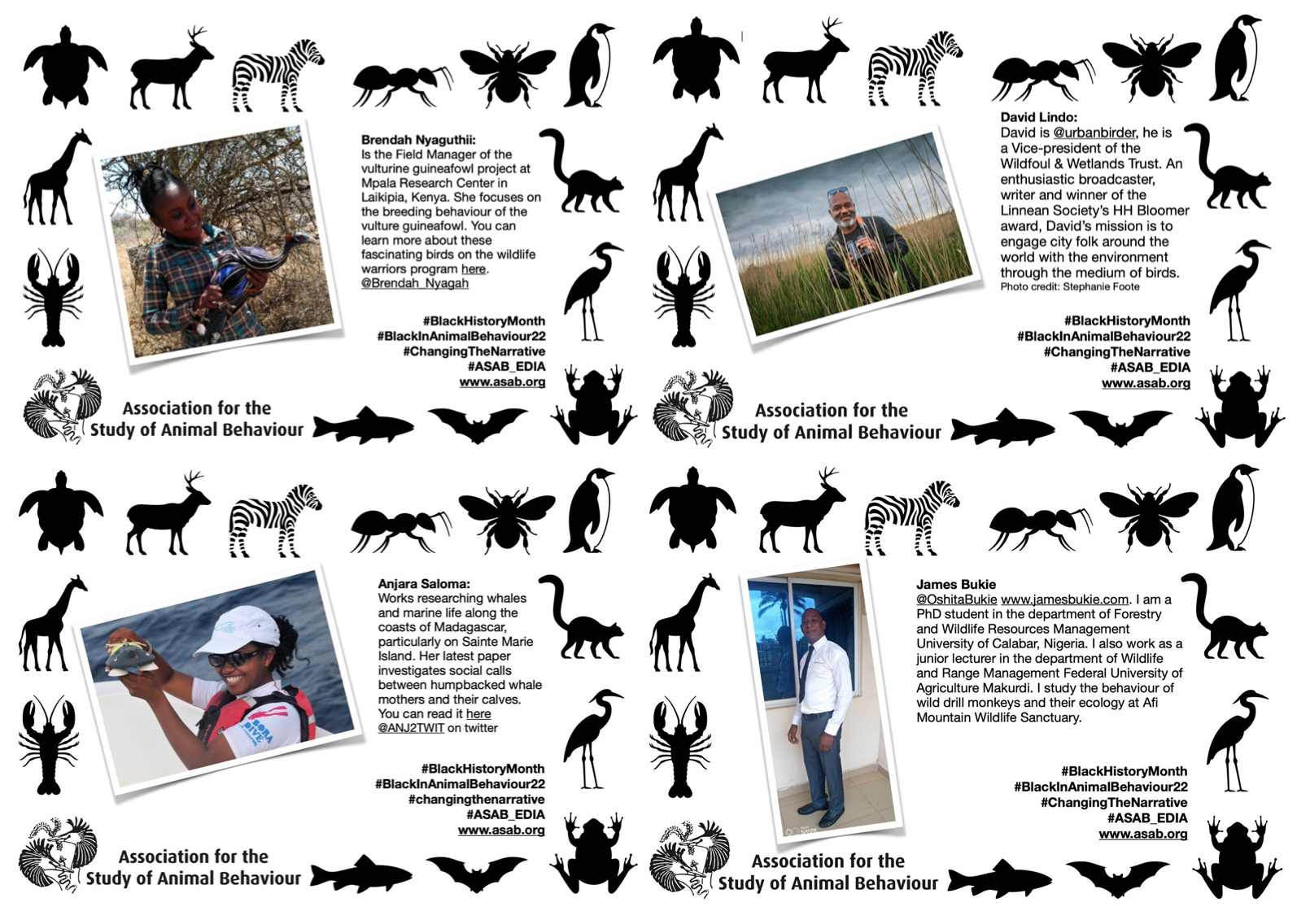
Brendah’s programme can be seen here: https://www.youtube.com/watch?v=waYA6wiUSRU
David’s website is: https://www.theurbanbirderworld.com
James’ website is: https://www.jamesbukie.com
You can read Anjara’s paper here: https://peerj.com/articles/13785/

We want to use our platform to amplify, applaud and also aim to tackle the under representation and support Black animal behaviour students and researchers. So, over the next month we are highlighting people in our community, here and on social media.

We are excited to present a talk for deaf awareness week 2022
6th of May 5pm
ASAB Dogs are brilliant: What we can learn from them and how they help us.
Dr Juliane Kaminski is a scientist at the University of Portsmouth where she is recognized as a leading expert on dog cognition and has been featured in the National Geographic and on Discovery News. Juliane works to discover what we can learn from one of our closest living domesticated species, the domestic dog. Juliane to going to tell us about her research interests, which include social cognition, communication and cooperation in human infants, primates and dog. Dogs being an important study species when it comes to comparative psychology. Most famously Juliane was the first to show that a dog named Rico learns words in a similar fashion as human infants.
Our second speaker is Joanna Jones, Joanna is supported by Marshall her Registered Assistance Dog. There are now over 7000 Registered Assistance Dogs in the UK that support people with disabilities and medical conditions. As well as Guide Dogs, other types include Hearing Dogs, Medical Alert Dogs and Autism Dogs. Hearing Dogs in particular, help their partners leave loneliness behind and reconnect with life. Joanna will talk about life with Marshall and the difference he makes to her world.
Come and listen, you're all very welcome, psychology/biology students, science lovers and dog lovers. There will time at the end for questions.
Our own Education Committee member Dr Lindsay Murray interviews Dr Jane Goodall - November 2021

Freedom of movement: If Oxford October 2021
How do animals get around in our modern world? Ecologists, storytellers, poets and comedians explore why animals move around and how human actions affect this movement. Take a spoken-word journey and see familiar landscapes afresh through the eyes of different species. Take charge of the story as we consider what can we all do to remove human-created barriers and give animals back their freedom of movement. This recording is taken from the IF Oxford Science Festival October 2021
Royal society of biology outreach and engagement symposium

RSB Connect 2021: bringing outreach and engagement into the future
RSB Connect 2021 is a three-day online bioscience outreach and engagement symposium. The event will include talks, presentations, Q&A sessions, workshops and networking to provide training, information and discussion of contemporary issues relating to outreach and engagement.
2020-21 has been a rollercoaster ride. This year’s symposium will summarise what we have learned during the pandemic, what new tools have made life better and how we can utilise the lessons learned to enhance outreach and engagement work for the future.
ASAB members can purchase conference tickets or day tickets for half price
#BEHAVIOURFLAVOURS COMPETITION

in conjunction with The Royal Society of Biology
In celebration of biology week, each day from the 6th-10th of October has been given a different animal behaviour theme. The theme, for example ‘foraging’, will be published each morning (8:30am or before) on Twitter, TikTok and Facebook. You will have all day (by 7pm) to upload (or email in to education@asab.org) your interpretation and/or explanation of that day’s animal behaviour. Tag it with #behaviourflavours. You will only have 15 seconds to communicate your ideas, so be creative, dynamic and fun! Each day has an animal behaviour expert judge and there are prizes for the best videos. Winners will be announced each evening on the social media platforms using the #behaviourflavours Sunday’s winner will be announced on Monday 11th October by our super guest judge and dance your PhD winner - Cedric Tan.
Science in Spanish
Dr Lucía Martina Martín López from The University of Liverpool was awarded a 2021 ASAB Education Committee Public Engagement Grant to translate research papers into Spanish for young people. Science Journal for Kids and Teens provides cutting-edge peer reviewed science research adapted for students and their teachers. Here are the first four articles. There are more on the way. If you are interested in applying for a Public Engagement grant look here.

How do bees choose what to eat?

How do termites divide the work?

Can we save rhinos from extinction?

Are poachers rhinos’ only problem?
The Access Project

The Access Project is looking for volunteers to support a disadvantaged young people aged 14-18 for 1 hour a week Sept-July with their academic studies, through our easy-to-use dedicated online platform. You’ll join a training session during the summer and begin in the early autumn.
Support a young person in a school subject to achieve the GCSE / A level grades they deserve and to fulfil their potential
Inspire, motivate and raise aspirations towards higher education & the world of work
Students supported by The Access Project typically achieve a grade higher at GCSE and are four times more likely than their peers to progress to a top-third ranked university.
No prior experience necessary, full training included with multiple training sessions over the summer and early autumn.
Questions? Please email volunteering@theaccessproject.org.uk
The Big Bang Digital 2021
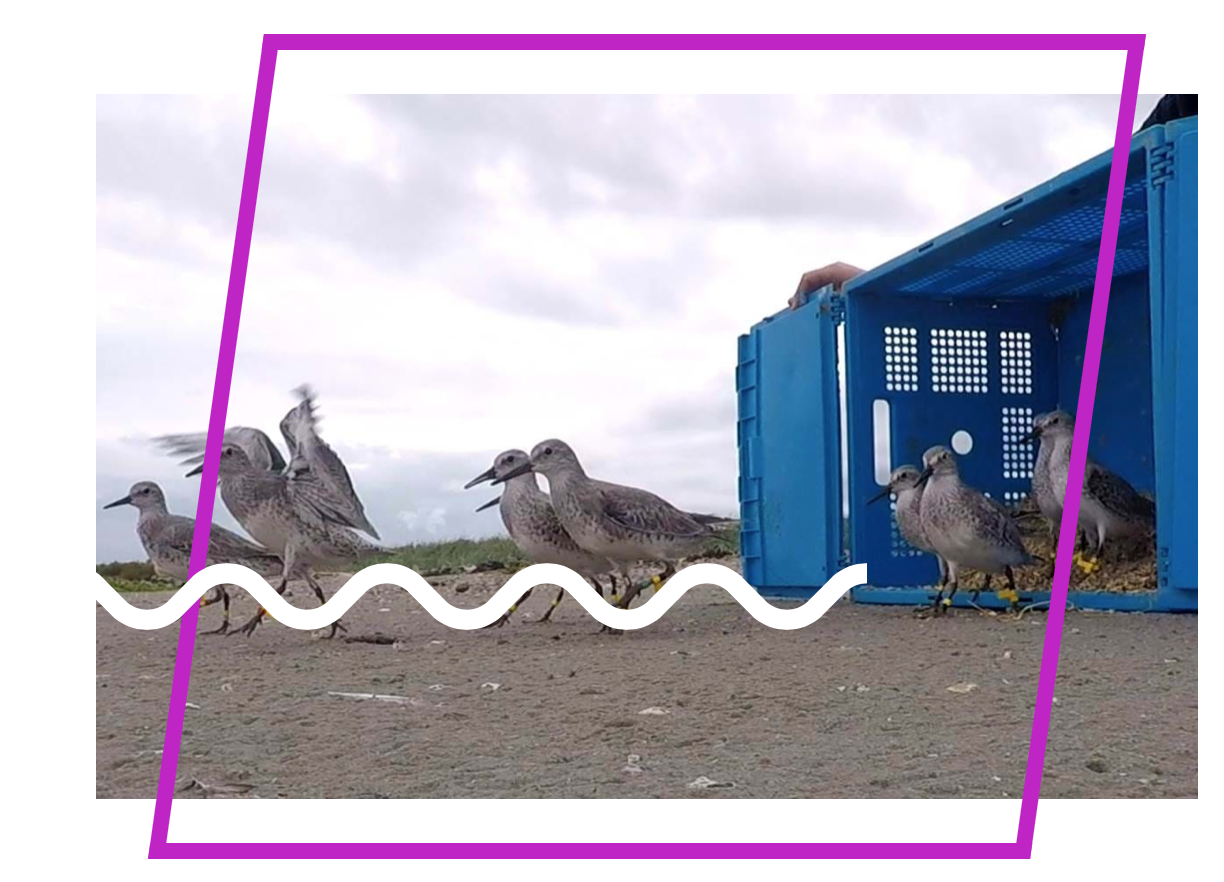

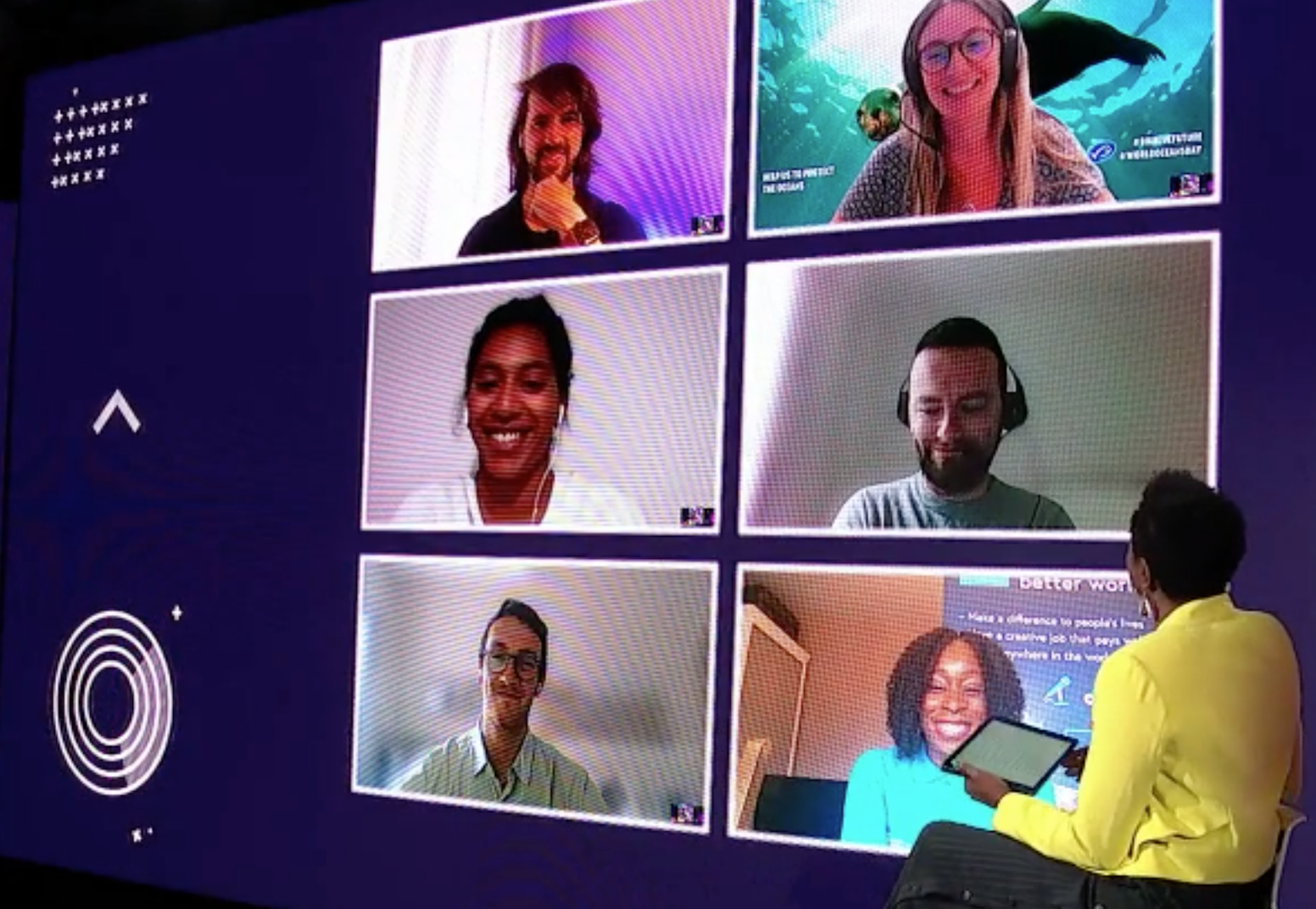
It’s a wrap for the live Big Bang Digital 2021! And there’s good news…
If you missed any of the sessions or want to watch again, everything from the programme is available online. This means if you missed Aileen’s video and Emma’s interview you’ll be able to watch it and download the worksheet.
Science at home
Last November (2020) we joined the Royal Society of Biology and lots of other amazing partner organisations for their first ever online science festival #RSBScienceAtHome! There are activities, talks, games and more, suitable for families of all ages and every aspiring scientist out there rsb.org.uk/science-at-home We launched ‘The ASAB Colouring Book’ containing thirteen pages of scientific colouring joy. Learnt about murmurations, vigilance behaviour, how bees find food and tell all their co-workers. A great big thank you to Steve Unwin who works at the University of Birmingham and is involved in research into health and ecosystem health, from a non-human animal perspective, including the health of apes in their wild habitats. He spoke in Zone 3 ‘Scientists at Work’.

Talks for teenagers
Summer 2020

8th of July at 2pm Are you a young person needing to stretch your brain? Would you like to learn some fascinating bird science from a real life scientist? Click here to register for your free ticket.

SOLD OUT: 24th of June 2pm Are you a young person fascinated by insects? Would you like to learn some science from a scientist? There are only a few tickets left for this online zoom event.
THE CATERPILLARS HAVE LANDED…
May 2020

Sutton African & Caribbean Cultural Organisation successfully applied for the ASAB Education Committee Public Engagement Grant. They had a fantastic idea to engage more than 30 families in science by giving them the best project during this time of social distancing: Rearing caterpillars and watching them emerge as butterflies. Follow @SaccoOrg on twitter for updates on the progress of the caterpillars and their guardians.
Bat & Primate Outreach
Feb 2020
With support from the ASAB Education Committee, bat conservationist Kristen Lear and primate scientist Kristen Morrow (University of Georgia) put together a science communication program for the Athens Clarke County Library teen program. The program compared bat and primate behavior and biology and provided students with a hands-on glimpse into how wildlife scientists study wild animals. With skeletal casts, recordings of bat echolocation and primate vocalizations, and an interactive flipboard, students learned about the differences and similarities in bat and primate anatomy and communication. Students got to practice being "bat biologists" through a mist netting activity in which they extracted (toy) bats from a net and practiced weighing and measuring them using the tools that bat biologists use. Students also played a primate foraging game and a bat echolocation game to learn how primates and bats forage. Finally, students got to use a virtual reality program that simulates how a nocturnal primate sees and hears the world around them. The goal of the program was to provide a fun, interactive event that got kids excited about animal biology and behavior science!


The Kraken Awakes! presented by Dr Gavan Cooke April 2020


Gavan has received the ASAB Education Committee Public Engagement Grant in order to educate the UK SCUBA diving community on cephalopod behaviour and wild animal welfare, whilst simultaneously sharing "The Cephalopod Citizen Science Project", https://www.researchgate.net/project/The-Cephalopod-Citizen-Science-Project or @CephCitScience on Facebook
Gavan will be travelling to the north of England and Scotland in the spring and talking to groups of SCUBA divers. His talk explains which cephalopods are found in UK waters, behavioural ecology, including feeding behaviour, reproductive behaviour, courtship, habitat choices. Gavan will also cover some unusual behavioural phenomena, such as octopuses found above the tide and wandering around the beach. Gavan will close the talk with wild animal welfare issues (and how to avoid them) and finally give details of the citizen science project and how the audience can participate.
Ridgeway Hawk Project

The ASAB education committee are delighted to announce that they have awarded their first Public Engagement Grant. The worthy recipients are The Peregrine Fund for their Ridgeway Hawk Project. You can find the @peregrinefund on twitter. The award will be used to support the critically endangered, endemic Ridgway's Hawk in the Dominican Republic. The Ridgeway Hawk Project works directly with young people from local schools, as these individuals can literally make the difference between whether Ridgway's Hawks survive in their area or not. Released hawks disperse through these local communities and sometimes choosing to nest nearby. It is of vital importance that the local people support hawk conservation. So the grant will go towards funding Ridgway's Hawk Day 2020 focusing on engaging young people with raptor behaviour and the importance of birds of prey to the environment.
You can find out more about the ASAB education committee's Public Engagement Grant page.
Resource news
The education committee has three new resources to share. Foraging and feeding is five fabulous lesson plans and lots of games to teach key stage one and two students about the behaviour of animals in natural environments. Vigilance behaviour in Meerkats provides educators with a comprehensive teaching pack to enable them to conduct behavioural observations in the classroom with students, through the medium of meerkat. Activity Packs for use at science fairs are read-to-roll activities based on animal behaviour to use at science fairs and related events.


The Public Engagement Grant

The ASAB Education Committee has launched a Public Engagement Grant for organizing and delivering innovative and exciting outreach activities. Awards of up to £2000 are available, with applications for less than the full amount also encouraged. The proposed activities should be aimed at young people and/or the general public, to communicate the science of animal behaviour. Examples might be exhibition stands at science fairs, food festivals and community events. School visits, museum workshops, local talks and cake competitions.

Carneddau Ponies: Their history, behaviour, communities and conservation.
Dr Susanne Shultz spoke at a public engagement event on behalf of ASAB about the Carneddau ponies of Snowdonia: how they are a cultural and natural resource of North Wales, and Susanne’s research with the ponies to understand horse behaviour in general, as well as microbiomes and management of these gut bacteria in domesticated horses. You can view her presentation here, and the Q&A session here.
Dr Susanne Shultz. Image courtesy of the Royal Society.

The ASAB Education Committee are proud supporters of Soapbox Scientists.

In 2019 the education committee has sponsored five soapbox scientists. A big congratulations to @kelly_jowett @SimsCassie @snorkel_maiden @DanERouse and @laleaver1. Contact education@asab.org.uk for more details.
In 2018 Lucy Mitchell talked about her PhD research into nightjar behaviour. Lucy uses GPS trackers to discover where they find their night-time meals, and where they like to sleep during the day. Lucy had some fun interactive moth catching games to find out what it's like to be a nightjar!
Josie Monaghan told the crowds about her research on conservation genetics in forest management. Josie explained that ant behaviour is an important aspect of the woodland ecosystems and how, by using the genetics of red wood ants, scientists will decide how best to look after our forests. Josie demonstrated the connectivity of the forest and show how we can use one (very small) animal to find out about how we affect forests - whether good or bad.

University of Sussex PhD student, Georgia Hennessy, spoke at the Brighton Soapbox Science event on the 2nd of June 2018. Georgia spoke about her research showing that increasing wind speeds influence a bee's ability to forage. To illustrate this, Georgia had Soapbox Scientist participants go fishing!
Soapbox science events are taking place across the country and across world this summer. Look here for more information. If you are taking part and would like to be considered for sponsorship by ASAB, then please email our Education officer Charlotte – for more details.
Image: Georgia in a bee keeping suit
SOAPBOX SCIENTIST CLARE ANDREWS
EXPLAINED HER RESEARCH TO THE PEOPLE OF NEWCASTLE
Clare's research compares starling chicks that had a difficult start in life with those that had an easier ‘chickhood’. Clare explained how getting off to a bad start in life, growing up in a nest where a chick had to fight for food, made the birds’ DNA age faster. It also made them behave less patiently and less optimistically when they grew up to be adults.